
Indian PR Industry Linked To $545 Billion Economic Impact: Ipsos White Paper Released At PRana 2026
by Newswire Network in NWN News on September 3, 2026The Indian PR industry has an estimated US$545 billion economic impact, with Ipsos attributing the value to brand awareness, reputation and crisis management.
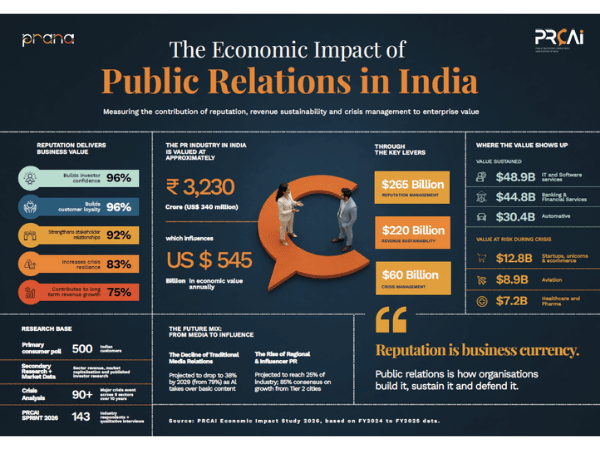
A public relations industry worth barely US$340 million in annual revenue is, by its own accounting, punching roughly 1,600 times above its weight. That’s the headline claim in a new white paper from Ipsos and the Public Relations Consultants Association of India (PRCAI), unveiled at PRana 2026, which puts the sector’s annual influence on the Indian economy at approximately US$545 billion.
The paper, titled The Economic Impact of Public Relations in India, draws on two Ipsos-led studies — the Economic Impact of Public Relations research and the SPRINT 2026 industry survey, Architects of Trust — to argue that PR’s real value lies not in what it costs clients, but in the revenue, reputation and crisis protection it helps preserve.
Three levers, one number
The $545 billion figure is built from three separate estimates, each modelled independently:
- Revenue sustainability and growth — ~$220 billion. Ipsos surveyed 500 Indian consumers across nine PR-heavy sectors (FMCG, IT, banking, automotive, healthcare, aviation, hospitality, education and startups) and found that PR-specific channels — journalist coverage, trade press, leadership interviews, analyst commentary — account for roughly a fifth of brand awareness. Applied to an estimated $1.2 trillion organised-sector base, that share works out to $220 billion in revenue the industry helps sustain.
- Reputation management — ~$265 billion, the largest of the three levers. Using existing investor-relations research showing that reputation drives close to 28 percent of investor decision-making, and applying the same 20 percent PR-attribution share, Ipsos estimates PR’s influence on India’s roughly $4.5–4.75 trillion listed market capitalisation at $265 billion.
- Crisis management — ~$60 billion. Analysing more than ninety corporate crises over the past decade — brand backlash, product-safety failures, governance scandals, cyberattacks — the study found an average hit of 0.35 percent to revenue and 1.5 percent to market value per event. Applied across the sectors studied, that erosion totals roughly $60 billion a year, framed as the value PR involvement helps protect.
Reputation coming out on top isn’t incidental to the paper’s argument: it’s central to it. The authors position reputation not as a soft, perceptual asset but as what they call a form of “business currency” with direct financial weight — a framing borne out in their own survey data, where 96 percent of corporate communicators credited PR with building investor confidence and customer loyalty.
Where the money sits — and where it’s exposed
Sector-level detail shows the revenue lever concentrated in IT and software services (~$48.9 billion) and banking and financial services (~$44.8 billion), followed by automotive and FMCG. But flip to crisis exposure and the picture inverts: education and edtech, a much smaller slice of the economy, showed the steepest proportional losses — over a third of market capitalisation at risk during crisis events — followed by aviation. Startups, tech unicorns and e-commerce led in absolute crisis losses, at an estimated $12.8 billion annually.
An industry in transition
The white paper doesn’t just size the market — it charts where the discipline is headed. Crisis and issue management is the fastest-growing service line, expected to be cited as a top revenue driver by 47 percent of consultancy heads within three years, up from 38 percent today, as more firms move from reactive crisis response to retained, standing engagements. PR’s share of client marketing budgets climbed from 12 to 14 percent between FY2025 and FY2026, with more than half of corporate communicators saying it’s pulling budget away from advertising and digital agencies.
Traditional media relations, meanwhile, is losing ground as a revenue driver even as the value of earned coverage rises — a dynamic the report ties directly to generative AI. As large language models become a primary gateway for brand discovery, 83 percent of practitioners surveyed said earned media’s importance is growing precisely because AI systems are now the ones deciding which sources are considered discoverable and credible. Content development, by contrast, is the one service area projected to shrink, as AI absorbs first-draft writing work.
Geographically, momentum is shifting west and south: while North India still accounts for 37 percent of industry revenue, the West (19.2 percent growth) and South (15.6 percent) are outpacing the 11 percent national average. Government has also emerged as a meaningful new client category, nearly tripling its share of industry revenue since 2022.
DOWNLOAD FULL REPORT: https://www.newswirenetwork.com/wp-content/uploads/2026/09/The-Economic-Impact-of-Public-Relations-in-India-Whitepaper.pdf