Key takeaways
- - Press releases remain journalists' most useful PR resource: 72% say so, according to Cision's 2025 State of the Media report.
- - Most news coverage still starts with PR. 84% of journalists say at least some of their stories begin with a pitch (Muck Rack, 2025).
- - Earned media drives AI visibility. More than 95% of links cited by AI tools come from non-paid sources (Muck Rack, 2025).
- - Trust is high in India. India scores 75 on Edelman's Trust Index, against a global average of 56, which makes credible news coverage especially valuable.
- - Well-placed releases keep working long after launch day, supporting branded search, SEO and reusable content.
- - Results depend on fit. Pick outlets your audience actually reads, and ask for a full report of live links.
Every few years someone declares the press release dead, and every year the research says otherwise. Newsrooms are smaller, inboxes are fuller and AI assistants increasingly answer questions that used to send people to search engines. In that landscape, a well-written, well-distributed press release does more than announce news. It feeds journalists, builds a public record that search engines and AI tools can find, and signals credibility to customers and investors.
This article looks at the main benefits of press release distribution for brands in India and globally, using recent industry research.
1. Credibility and trust that paid media can’t buy
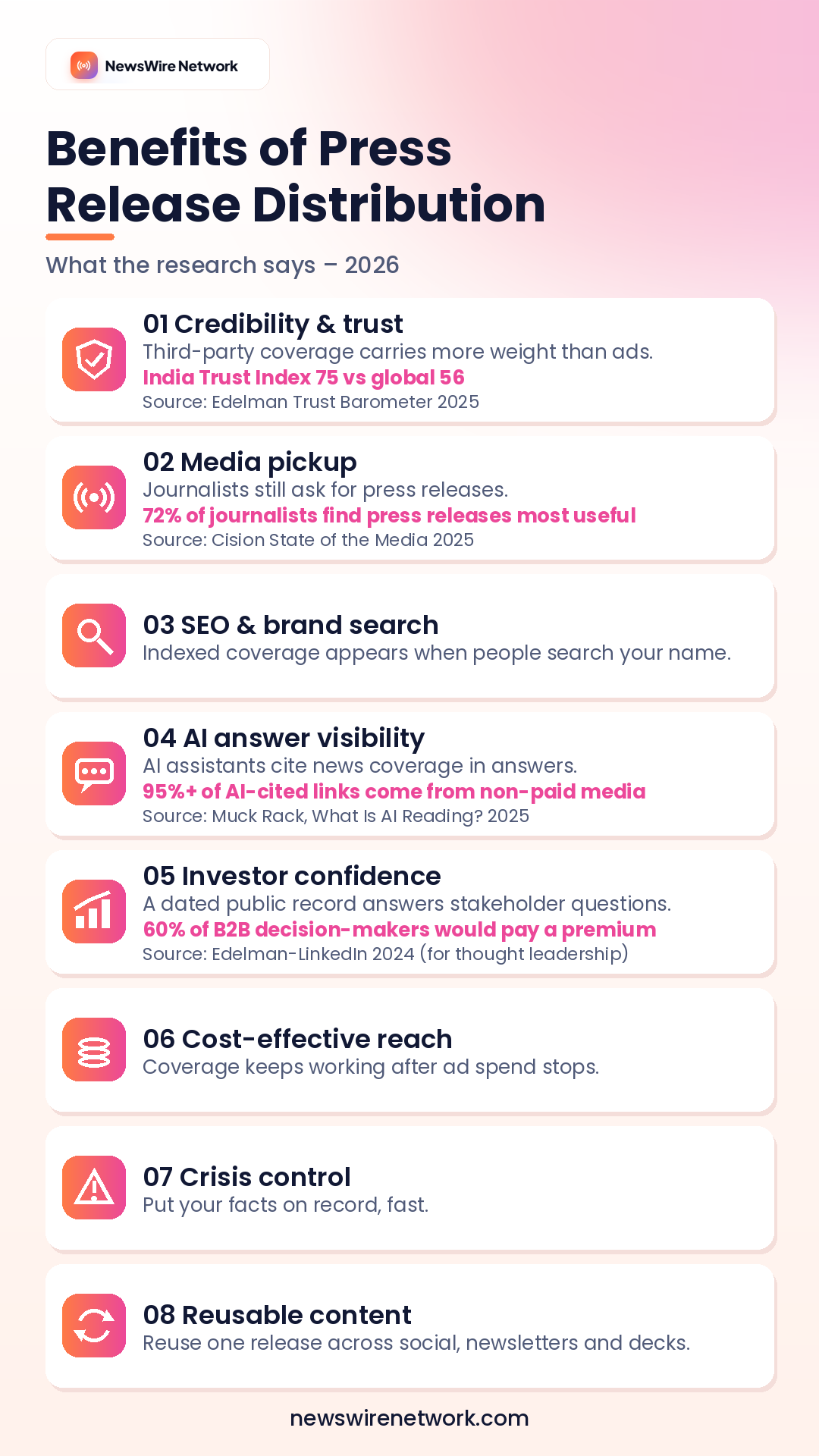
People trust information more when it comes from someone other than the brand itself. Nielsen’s Trust in Advertising study (2021), which surveyed more than 40,000 consumers, found that 88% of respondents trust recommendations from people they know more than any other channel. Paid formats such as online banners, mobile ads and search ads were trusted far less. Recommendations aren’t the same as news coverage, but the principle carries over: third-party voices carry more weight than brand-controlled messages.
India offers a fertile setting for this. The 2025 Edelman Trust Barometer gave India a Trust Index of 75, an average of trust in business, government, media and NGOs, compared with a global average of 56 across 28 countries. In a market where institutions, including media, are relatively well trusted, appearing in credible publications gives a brand’s story real weight.
2. Media pickup: journalists still want press releases
Despite talk of the format’s decline, journalists keep asking for it. Cision’s 2025 State of the Media report, based on more than 3,000 journalists across 19 markets, found that 72% named press releases as the most useful resource PR teams can provide.
Muck Rack’s State of Journalism 2025, which drew responses from the US, UK, Canada and India, adds that 84% of journalists say at least some of their stories originate from PR pitches. The same survey carries a warning: 86% disregard pitches that aren’t relevant to their beat. Distribution works when the news is real and reaches the right desks.
3. SEO and brand search
A distributed release creates indexed pages on news and industry sites that mention the brand, its leaders and its products. Those pages can appear when people search for the company by name, which is often the moment a prospect, journalist or investor decides whether a business is credible. Coverage can also lead to editorial mentions and links over time.
It’s worth being realistic. Most links inside syndicated releases are nofollow, and search engines don’t reward volume for its own sake. The SEO value comes from visibility, from people searching for the brand by name after seeing coverage, and from the genuine editorial coverage a good release sometimes triggers.
4. Visibility in AI answers
This is the newest and fastest-growing benefit. Tools such as ChatGPT, Gemini and Claude increasingly cite web sources in their answers, and news coverage is one of the sources they rely on most. Muck Rack’s What Is AI Reading? study (2025) analysed AI-cited links from hundreds of thousands of prompts. It found that more than 95% of cited links came from non-paid sources and 27% came from journalistic content.
Recency matters as well. According to Muck Rack’s summary of the findings, journalism accounted for 49% of citations on queries implying recency, and the single most common publication date for cited content was the day before the query. For brands, regular, newsworthy announcements on credible outlets are one of the few levers available for showing up in AI-generated answers.
5. Investor and stakeholder confidence
For listed companies, press releases are often part of the disclosure process, and established wires exist largely for this reason. For startups and private companies, a consistent public record of funding rounds, partnerships, product launches and leadership hires does a similar job. Investors, lenders, partners and prospective employees typically research a company online before engaging. A trail of dated, independently published announcements answers many of their questions before they ask.
Thought leadership has a similar effect. The 2024 Edelman-LinkedIn B2B Thought Leadership Impact Report found that 60% of B2B decision-makers said they were willing to pay a premium to work with organisations that produce valuable thought leadership. Releases that share original data, research or expert commentary can support that kind of positioning.
6. Cost-effective reach compared with advertising
Advertising stops working when the spend stops. A published news item, on the other hand, can be found for months or years, keeps appearing in brand searches and can be cited by journalists and AI tools long after the release date. Distribution isn’t free, but it creates lasting assets rather than rented attention. That’s why many teams, especially startups and SMEs in India, use releases to support paid campaigns rather than replace them.
7. Crisis communication and reputation control
When something goes wrong, such as a product recall, a data incident or a leadership change, an official statement distributed through a credible channel puts the company’s position on record quickly and accurately. Journalists have a primary source to quote, and the company’s version sits alongside other coverage in search results instead of being drowned out by speculation. A release can’t fix a crisis, but it ensures the company’s facts are part of the record.
8. Content that keeps working
A single release can be repurposed into social posts, a newsroom page, newsletter copy, sales enablement material, investor updates and pitch decks. Coverage can be quoted on websites and in proposals (“as featured in…”), and it builds a library of announcements that shows a company’s momentum over time. Cision’s 2025 research also highlights that journalists value multimedia, so releases with good images, data and quotes are easier to reuse both internally and by the press.
How to get the most from a press release
· Lead with real news. Funding, launches, partnerships, data and milestones get picked up. Vague announcements get ignored.
· Target the right audience. Choose distribution that reaches the outlets and regions that matter. For Indian audiences, that typically means national business media and wire agencies. Services offering press release distribution in India, such as NewsWire Network, PR Newswire’s India service and NewsVoir, focus on this market.
· Keep it tight and factual. A clear headline, the key facts in the first paragraph, a quotable line and a named media contact make a journalist’s job easier.
· Add assets. Images, data and short videos increase usefulness for both journalists and readers.
· Ask for proof. Insist on a report of live links so you know where the release actually appeared.
· Publish consistently. A steady cadence of genuine news builds the public record that search engines and AI assistants draw on.
Frequently asked questions
Are press releases still effective in 2026? Yes, when they carry genuine news. Cision’s 2025 research found that 72% of journalists consider press releases the most useful resource from PR teams, and Muck Rack’s 2025 survey found that 84% say at least some of their stories originate from PR pitches.
Do press releases help with SEO? Indirectly. They create indexed coverage that appears in brand searches and can lead to editorial mentions. Links in syndicated releases are usually nofollow, so the value lies in visibility and credibility rather than direct link equity.
How do press releases affect AI search tools like ChatGPT? AI assistants frequently cite news content, especially for recent topics. Muck Rack’s 2025 study found that journalism made up 27% of AI-cited links overall and 49% for queries implying recency. Coverage on credible outlets increases the chance that a brand’s news appears in AI answers.
Is press release distribution useful for small businesses and startups in India? Yes. For newer companies, coverage provides third-party validation that customers, partners and investors look for, and a growing record of announcements builds visibility over time.
Conclusion
Press releases have evolved rather than disappeared. Journalists still rely on them, the public still trusts third-party coverage more than advertising, and AI assistants increasingly draw on news content when they answer questions. For brands in India and around the world, a steady flow of genuine, well-targeted announcements builds credibility, supports search visibility, reassures stakeholders and creates content that keeps working long after release day. The key is substance: real news, distributed to the right outlets, with proof of where it landed.
 Send on WhatsApp